Voice bots got better in 2026, but not in the way people like to talk about.
The real shift isn’t “WER dropped 2 points.” It’s that the teams shipping good voice agents treat STT/TTS as a streaming system with a real latency budget, real failure modes (barge-in, crosstalk, endpointing), and real ops needs (tracing, fallbacks).
This post is performance-first and builder-biased:
- Open-source where it actually matters (cost, privacy, control)
- Hosted when it’s the only way to get reliability today
- Workflows that make the bot feel human (not just a nice voice)
The latency budget (what actually makes it feel “live”)
A useful rule of thumb:
- < 500ms total perceived latency: feels live
- 500–900ms: feels robotic
- > 900ms: users start talking over it (and your system breaks unless you built interruption correctly)
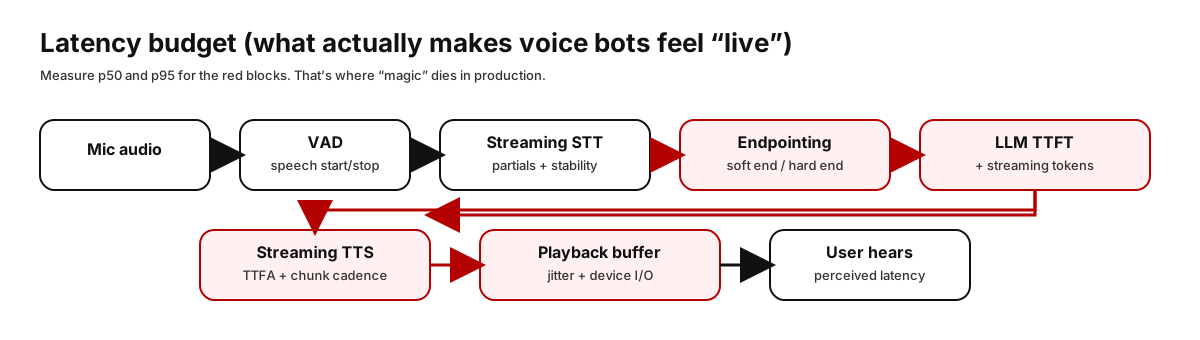
Here’s where the time actually goes:

If you aren’t measuring p95 on the red blocks, you don’t know why your bot feels slow.
Pipecat: open-source voice pipelines are maturing (and tracing is the tell)
Pipecat matters because it’s not “just a demo framework.” It’s turning into an integration surface for real-time voice stacks:
- plug-and-play STT/LLM/TTS components
- VAD + turn logic
- and, importantly: observability
The easiest way to spot who’s serious about voice agents: they’re talking about tracing.
There’s a concrete pattern floating around right now: instrument a classic STT → agent → TTS pipeline with OpenTelemetry, ship spans like stt/llm/tts/turn/conversation, attach turn audio, and debug turn-by-turn in LangSmith.
That’s the right direction. If you can’t trace turn-level latency, endpointing decisions, and TTS TTFA, you’re debugging a distributed system by vibes.
Also worth calling out: Pipecat is getting “bus-like.” Example: Pipecat MCP server working with local STT (Whisper) and local TTS (Kokoro).
Pipecat MCP server works with local Whisper STT + Kokoro TTSAnd Pipecat has a growing ecosystem of clients and templates (Android demo client, etc.):
Pipecat Android demo client + simple chatbot exampleReality check (what breaks after the demo)
A builder story I like because it’s honest: audio leakage, thread scheduling, and the fact that 100–200ms of coordination delay is enough for a couple words to leak through.
Builder report: full-duplex voice bot w/ Pipecat + Faster-Whisper + Kokoro (leakage + barge-in pain)This is the part that separates “cool demo” from “shippable product.”
Parakeet (MLX): local streaming STT is having its moment
Local-first STT isn’t ideology. It’s a latency + reliability hack.
Right now, Parakeet on Apple Silicon via MLX is getting real-world traction as:
- a default local transcriber
- and a fallback for always-on voice UX
A crisp example: cloud STT for general use + Parakeet MLX streaming locally on Apple Silicon.
Field report: Deepgram Nova-3 + Parakeet MLX streaming local fallbackSome specific Parakeet signals worth noting (treat as field reports, then benchmark yourself):
- “quality ~ Whisper medium/large but ~10× faster”
- v3 supports ~25 languages
- “native audio length” around 24 minutes (vs Whisper-style 30s chunking)
There’s also momentum toward native app integration (Swift ports):
Parakeet → Swift: port to native Mac/iOS appsVoxtral (“voxel”) and the new class of speech-native models
Quick note because people keep mixing terminology: a lot of what I’ve seen recently isn’t “voxel TTS” — it’s Voxtral, which shows up in the same local-voice conversations as Parakeet.
One field report claims Parakeet TDT 0.6B is “80–130× faster” and Voxtral 3B via MLX is “9× faster” on an M4 Pro.
MLX speed notes: Parakeet TDT 0.6B and Voxtral 3B (field report)Treat these as directional signals, not gospel. The important point is that we’re getting more speech-native models that are competitive locally, which changes the economics of always-on voice.
The pattern that keeps winning
If you’re building for consumers (or anything always-on), the architecture that keeps showing up is:
- local streaming STT first (Parakeet MLX / faster-whisper)
- cloud STT fallback when noise/accents/conditions get rough
That’s how you get low latency and coverage.
Endpointing is the hidden boss fight
Most voice bots feel bad because endpointing is bad.
- Too early: you cut people off.
- Too late: dead air.
- Thrashy partials: your LLM gets garbage.
Don’t pretend endpointing is a single silence threshold. Treat it like a policy:
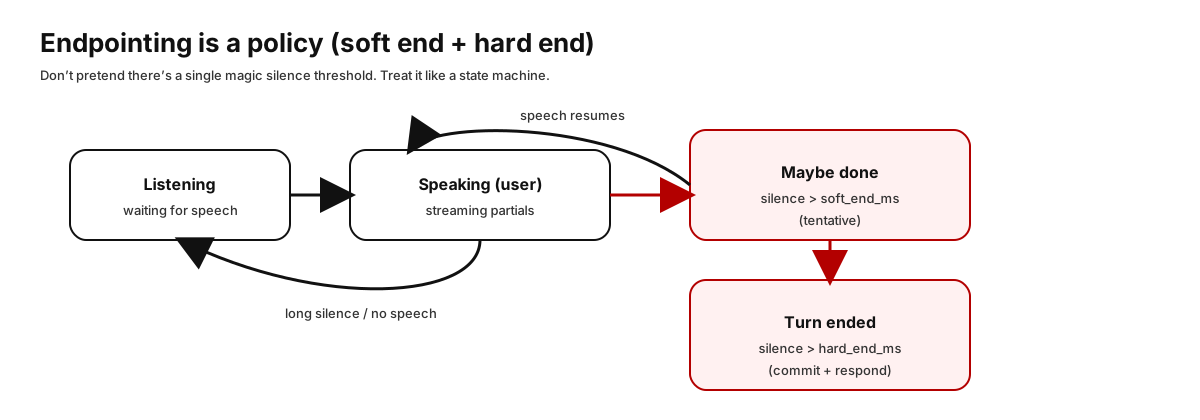
One modern “plumbing” update that’s directly relevant here: Speechmatics talking about a ForceEndOfUtterance mechanism to finalize transcripts in <250ms, available in Pipecat.
Speechmatics: ForceEndOfUtterance for <250ms finalization (Pipecat support)This is a good example of why “STT” isn’t just WER anymore.
Newer TTS: the current bar is streaming + low TTFA + concurrency
TTS is where teams quietly lose the latency budget.
If your TTS can’t stream cleanly, you end up generating paragraph-audio, and your bot feels like it’s waiting to speak.
Arcana v3 (Rime): performance + timestamps + concurrency (shipping integrations)
This is a very “2026” set of claims to evaluate:
- ~120ms latency
- multilingual 10+ languages
- word-level timestamps
- 100+ concurrency
- cloud + on-prem
- and availability across LiveKit/Pipecat/Telnyx/etc.
Even if you’re open-source biased, this matters because it sets the bar for what a production TTS provider is optimizing for.
Chatterbox Turbo (MIT licensed): open-source TTS with aggressive claims
This is getting passed around as a “DeepSeek moment” for voice:
- MIT licensed
- “<150ms time-to-first-sound”
- 5s voice cloning
- paralinguistic tags (expressivity)
I’m not going to repeat the hype. The right response is: benchmark it like an engineer.
Measure:
- TTFA p50/p95
- streaming chunk cadence (does it glitch?)
- long-form stability (drift)
- pronunciation control for names/jargon
- how fast it can stop talking (barge-in)
Open-source TTS you should still keep on your radar
Two projects that look like “real open releases” (not just a paper repo) because they’re being adopted and productized:
Qwen3‑TTS: open-sourced family release (LocalLLaMA thread) CosyVoice ONNX/edge port signal (ecosystem productization)
The workflow: how to build a voice agent that doesn’t collapse under real users
Here’s the non-negotiable pipeline if you want it to feel conversational:
- audio in → VAD
- streaming STT partials
- endpointing (soft end / hard end)
- LLM streaming response (optimize TTFT)
- streaming TTS immediately from partial text
- playback with barge-in
Barge-in rule:
- the moment VAD detects user speech start: duck/stop assistant audio
- keep recording; don’t drop frames
- send the interruption to the LLM as first-class input (“user interrupted while you were saying X”)
If the user speaks and your bot keeps talking, you built an IVR.
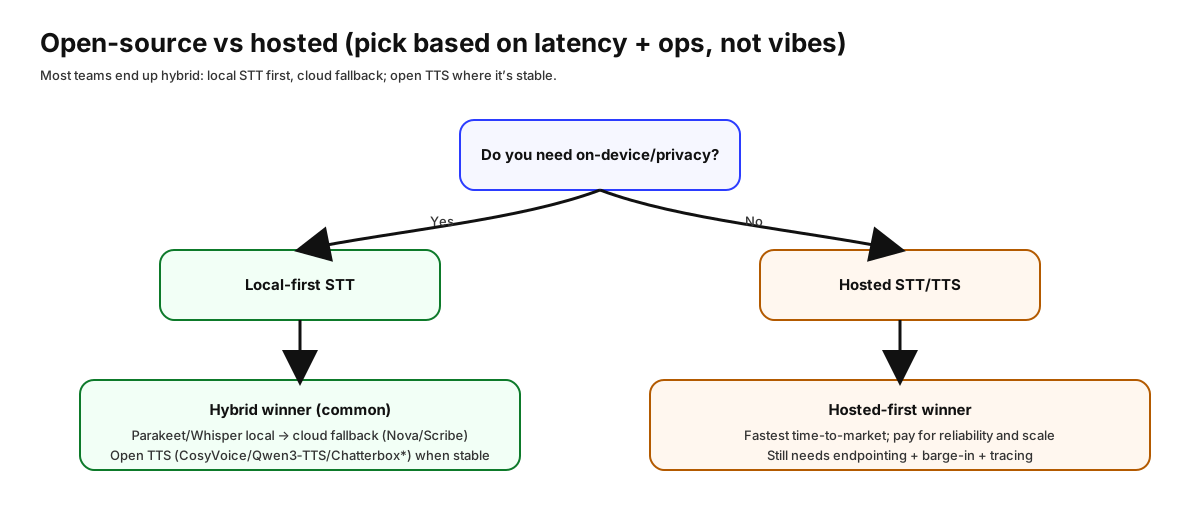
How to choose: open-source vs hosted (pick based on latency + ops)
Most teams end up hybrid. That’s not a compromise — it’s the optimal point on the reliability/cost curve.
What I’d ship today (if I cared about performance and cost)
Default architecture: hybrid.
- STT: local streaming (Parakeet MLX / faster-whisper)
- fallback STT: a fast cloud model when conditions get rough
- TTS: start with a low-TTFA streaming provider; bring open-source in when you can benchmark + stabilize it
- orchestration: Pipecat-style pipeline
- debugging: tracing (turn-level), not logs
Because the endgame is boring:
- measure p95
- optimize the slow blocks
- add fallbacks
- make interruption bulletproof
That’s what “good voice” actually is.