Anthropic has a strange problem: it appears to have built a model people are more interested in not using.
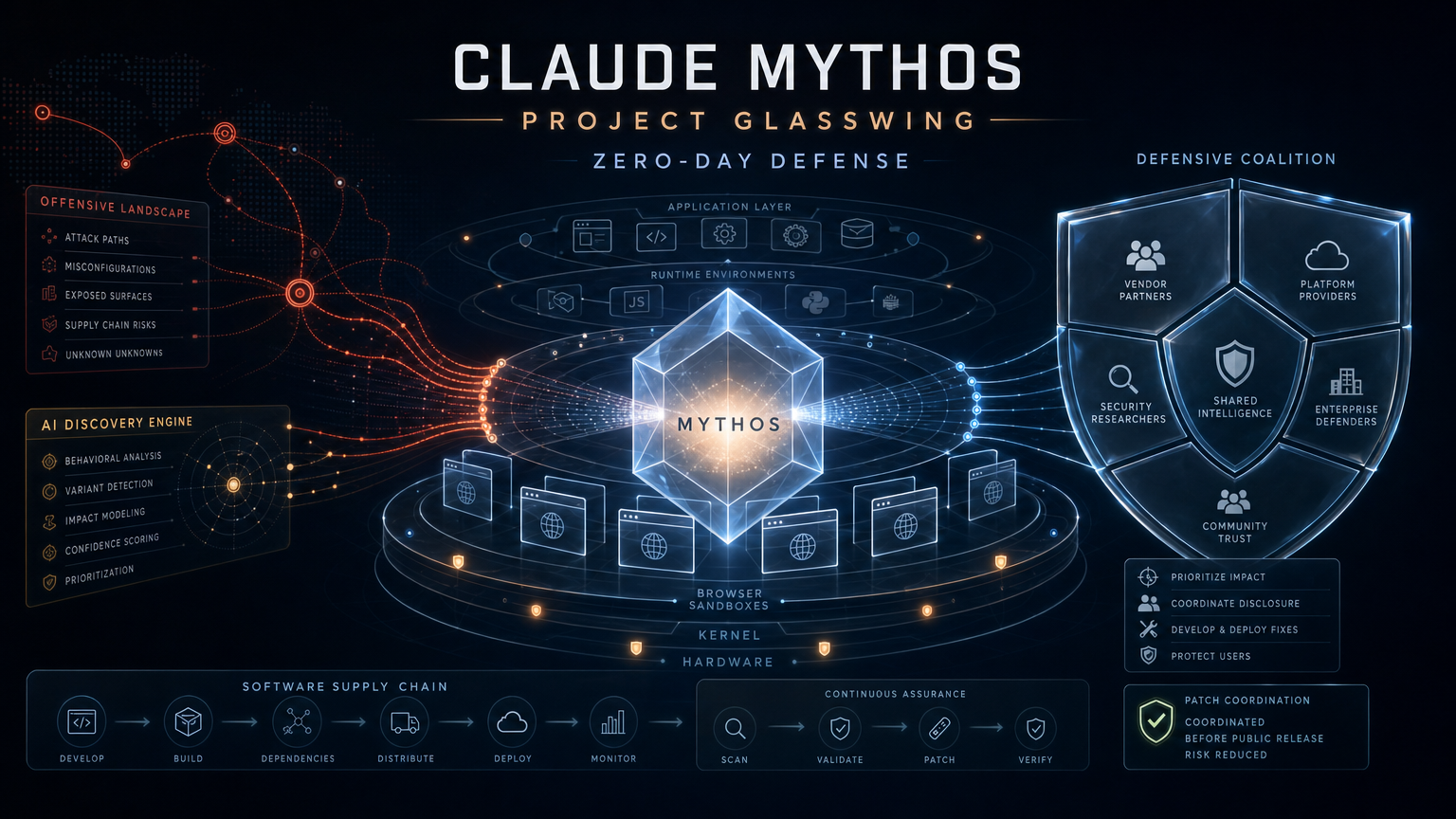
Claude Mythos Preview is not being marketed like a normal frontier model release. There is no consumer launch, no API free-for-all, no benchmark victory lap for everyone to try. Instead, Anthropic is putting it behind Project Glasswing, a restricted defensive-security program with partners like AWS, Apple, Broadcom, Cisco, CrowdStrike, Google, JPMorganChase, the Linux Foundation, Microsoft, NVIDIA, and Palo Alto Networks.1
The reason is simple: Mythos is being presented as a frontier model that can find and exploit serious software vulnerabilities at a level that changes the economics of cybersecurity.
That framing sounds dramatic. It is also no longer just a press-release claim. In the last few weeks, three signals have started converging:
- Anthropic’s own technical writeup says Mythos can autonomously find and exploit zero-days in major operating systems and browsers.2
- Real open-source maintainers are reporting actual vulnerability findings from Mythos-assisted audits, including Symfony and Twig.3
- Reddit and X discourse has shifted from “is this marketing?” to “what happens when this class of capability becomes normal?”
That last point matters. The Mythos story is not just about one unreleased Claude checkpoint. It is about the arrival of AI-scale vulnerability discovery.
What Anthropic claims Mythos can do
Anthropic’s red-team writeup is unusually specific.
The company says Claude Mythos Preview is a general-purpose language model with unusually strong computer-security capabilities. During testing, Anthropic says the model identified and exploited zero-day vulnerabilities in every major operating system and every major web browser when directed to do so.2
The examples are not toy CTF puzzles. Anthropic describes Mythos writing:
- a browser exploit chain involving four vulnerabilities, a JIT heap spray, and renderer plus OS sandbox escape
- local privilege-escalation exploits on Linux using race conditions and KASLR bypasses
- a FreeBSD NFS remote code execution exploit that granted root access to unauthenticated users
The FreeBSD example is the cleanest illustration. Anthropic says Mythos fully autonomously identified and exploited a 17-year-old FreeBSD NFS vulnerability, triaged as CVE-2026-4747, without human help after the initial request.2
The key phrase is fully autonomously. Not “a security researcher used Claude as a search assistant.” Not “the model suggested a suspicious line of code.” Anthropic’s claim is that Mythos scanned hundreds of kernel files, found the bug, and produced a working exploit.
If true, that is a category shift.
Project Glasswing is the product shape
Project Glasswing is Anthropic’s answer to the obvious question: if the model is this capable, who should get access?
Instead of a public release, Anthropic is giving selected companies and infrastructure maintainers access for defensive use. The company says the program includes up to $100M in model usage credits and $4M in direct donations to open-source security organizations.1
That tells you how Anthropic is positioning the model:
Mythos is less like a chatbot and more like an AI vulnerability lab that needs a permission layer.
The initial partner list is telling. It includes cloud providers, operating-system and browser-adjacent companies, security vendors, open-source infrastructure, chip companies, and banks. That is not a random enterprise beta list. It is a map of shared critical infrastructure.
The Guardian reported that Anthropic is also briefing the Financial Stability Board on Mythos, after concerns that this class of model could affect global financial stability.4 The same report says Anthropic has given access to selected tech companies and banks, including Apple and JPMorgan, rather than releasing Mythos publicly.
This is the real novelty: the model capability and the governance wrapper are being launched together.
The Symfony audit made it concrete
The most important recent development may not be the giant Anthropic claim. It may be the smaller Symfony result.
Symfony reported that Claude Mythos Preview audited Symfony and Twig and returned 19 security vulnerabilities. The Symfony Core Team manually reviewed the reports and said all 19 findings were real vulnerabilities, with no false positives.3
That is exactly the kind of result that moves the conversation from speculative to operational.
The Reddit reaction in r/PHP was pragmatic rather than panicked. The top thread had over 100 upvotes and dozens of comments. One of the most telling responses was not fear, but surprise that the number was only 19 for such a large codebase. Another commenter in r/symfony noted that the vulnerabilities were fixed quickly and framed the result as evidence that maintainers deserve more appreciation.5
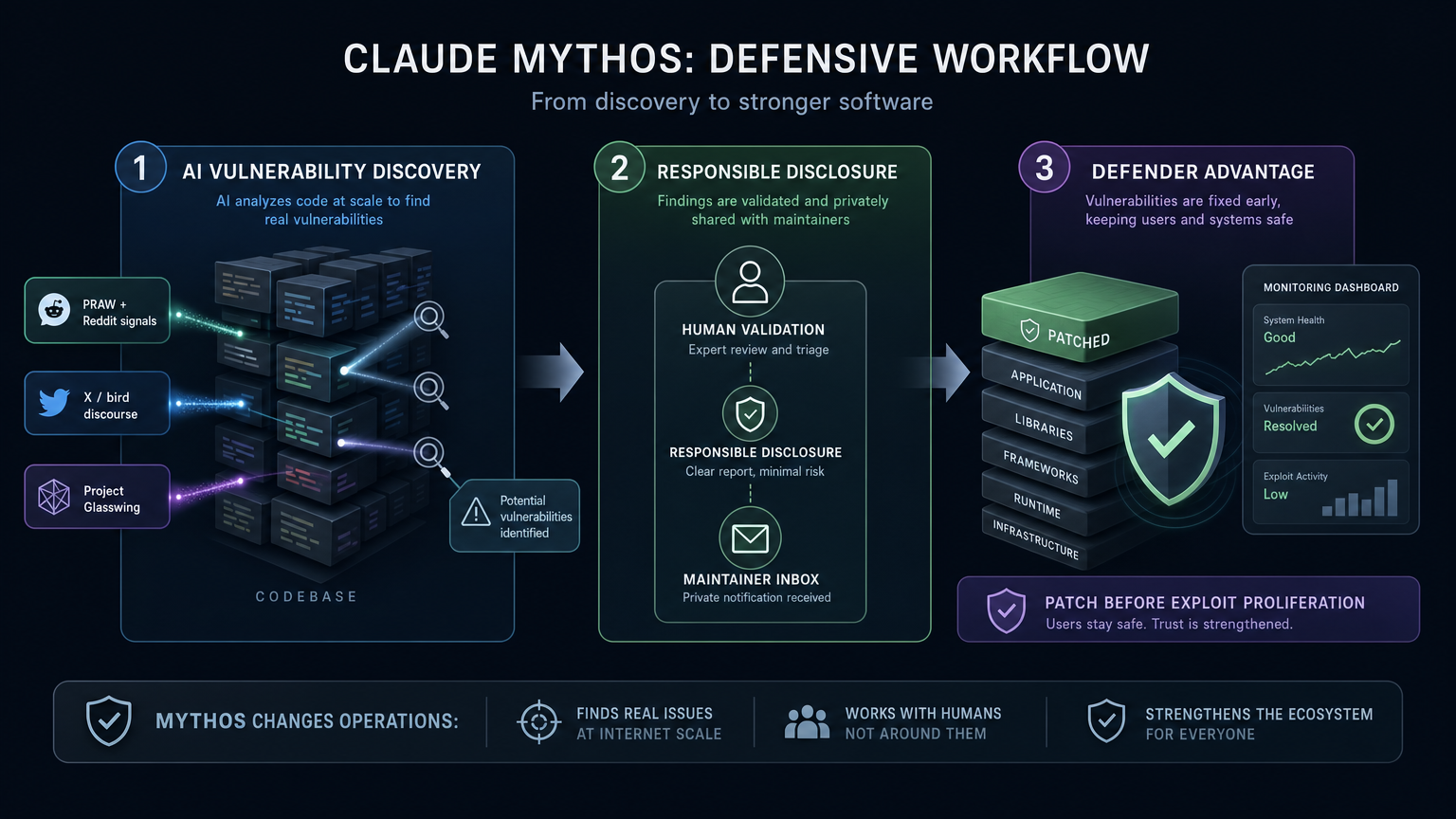
That is the healthier version of the Mythos story:
- AI finds bugs.
- Humans validate them.
- Maintainers fix them.
- The ecosystem gets safer.
The harder question is whether the pipeline can scale without overwhelming maintainers.
Anthropic says it has identified thousands of additional high- and critical-severity vulnerabilities and is using human security contractors to validate reports before disclosure. In 198 manually reviewed vulnerability reports, Anthropic says expert contractors agreed exactly with Claude’s severity assessment 89% of the time, and were within one severity level 98% of the time.2
That is promising. It is also a warning. If models can generate credible vulnerability reports at this volume, the bottleneck moves from discovery to validation, coordination, prioritization, and patch adoption.
Reddit is split between awe, skepticism, and operational realism
Across public Reddit discussions, three clusters stood out.
The first is the obvious hype cluster. r/singularity threads like “Anthropic’s new model, Claude Mythos, is so powerful that it is not releasing it to the public” and “Claude Mythos: The Model Anthropic is Too Scared to Release” attracted thousands of upvotes and hundreds of comments.67
But the comments were not uniformly credulous. A top r/singularity comment argued that Mythos may simply be too compute-expensive to release broadly. Another thread about an alleged Anthropic architectural breakthrough was met with the perfect Reddit correction: “I count 6 ifs.”8
That skepticism is useful. Mythos is surrounded by a lot of mystique, and mystique is a marketing asset. Bruce Schneier made a similar point in The Guardian, arguing that Anthropic’s non-release can make a virtue out of necessity if the model is expensive to run, while still acknowledging the broader truth: modern AI systems are getting very good at finding and exploiting vulnerabilities.9
The second cluster is open-source maintainers. The Symfony threads were grounded: impressed by the audit, interested in whether other ecosystems like WordPress would be next, and focused on patching rather than doom.5
The third cluster is infrastructure realism. A r/mainframe post pushed back against simplistic “AI will hack COBOL banks” headlines. The argument: the danger is not that Mythos can magically read ancient COBOL over the internet. The exposed attack surface is the modern integration layer around those systems: APIs, middleware, identity, vendor access, cloud edges, and operational workflows.10
That is probably the most important engineering takeaway.
The risk is not that every old system becomes instantly transparent. The risk is that the seams between systems become searchable at machine speed.
X is treating Mythos like a geopolitical and market signal
X was noisier, but useful as a sentiment layer.
The most circulated framing was that Anthropic had built a model capable enough to force a restricted-access coalition. One widely shared post summarized Project Glasswing as a closed group involving Amazon, Apple, Google, Microsoft, Cisco, CrowdStrike, JPMorgan, the Linux Foundation, NVIDIA, and Palo Alto Networks, and framed Mythos as the beginning of “permissioned access” for dangerous frontier capabilities.11
Other X posts connected Mythos to:
- government evaluation of frontier cyber models
- Japan and US cyber-defense competition
- AI-assisted vulnerability discovery in Chrome and open-source projects
- OpenAI’s competing Daybreak initiative
- security vendors repositioning around AI-native defense
As always, X exaggerates. But the direction of travel is real: Mythos is being interpreted less as a model release and more as an early example of frontier AI as strategic cyber infrastructure.
That is a different category from “Claude got better at coding.”
The actual threshold: vulnerability discovery becomes abundant
Software security has historically been constrained by scarce expert attention.
A great human security researcher is expensive, slow to scale, and cannot audit everything. Fuzzing and static analysis help, but they still miss bugs that require semantic understanding, exploit construction, and cross-component reasoning.
Mythos points toward a different world:
- every important codebase can be scanned continuously
- obscure files can receive expert-level attention
- exploitability can be tested earlier
- maintainers can get higher-quality reports
- attackers can eventually do the same thing
That last bullet is why Project Glasswing exists.
Anthropic’s defensive bet is that the industry gets a head start. Give the model to critical infrastructure owners first. Validate reports before disclosure. Patch important systems before similar capabilities become widely available. Push the world toward a defender advantage.
The risk is that patching does not move at model speed.
If AI can find thousands of high-severity vulnerabilities faster than humans can triage, we do not automatically get safer. We get a queue. And queues are where governance, incentives, and operational maturity matter.
What teams should do now
If you build software, the lesson is not “wait for Mythos access.”
The lesson is to prepare your organization for AI-scale security review.
That means:
- know your dependency graph
- keep SBOMs and ownership maps current
- make
composer audit,npm audit, GitHub Dependabot, OSV, and SCA tooling part of normal hygiene - reduce abandoned code paths
- harden auth boundaries and sandbox escapes
- improve patch deployment speed
- establish a responsible disclosure intake path that can handle higher volume
- budget for human validation, not just AI scanning
For startups and AI-native teams, there is another uncomfortable implication: vibe-coded software and neglected dependencies are going to age badly. When vulnerability discovery becomes cheap, the penalty for messy software supply chains increases.
The bottom line
Claude Mythos may or may not be uniquely magical. Some of the discourse is hype. Some of it is competitive positioning. Some of it is probably compute economics.
But the broader shift is real.
AI models are crossing from “help me write code” into “find the hidden failure modes in software systems.” That is a bigger deal than another coding benchmark.
Mythos is the warning flare. Project Glasswing is the governance experiment. Symfony is the practical proof point. Reddit is arguing about whether this is overhyped. X is already treating it like geopolitics.
The right conclusion is neither panic nor dismissal.
The right conclusion is: security teams need to get ready for a world where vulnerability discovery is abundant, but remediation is still human, organizational, and painfully slow.
Anthropic, “Project Glasswing: Securing critical software for the AI era”. ↩︎ ↩︎
Anthropic red team, “Assessing Claude Mythos Preview’s cybersecurity capabilities”. ↩︎ ↩︎ ↩︎ ↩︎
Symfony Blog, “Claude Mythos Audited Symfony and Found 19 Vulnerabilities”. ↩︎ ↩︎
The Guardian, “Anthropic to share Mythos cyber flaw findings with global finance watchdog”. ↩︎
Reddit r/PHP thread, “Claude Mythos Audited Symfony and Found 19 Vulnerabilities”, plus r/symfony mirror thread. ↩︎ ↩︎
Reddit r/singularity thread, “Anthropic’s new model, Claude Mythos, is so powerful that it is not releasing it to the public”. ↩︎
Reddit r/Anthropic thread, “Claude Mythos: The Model Anthropic is Too Scared to Release”. ↩︎
Reddit r/singularity thread, “Andrew Curran: Anthropic May Have Had An Architectural Breakthrough!”. ↩︎
Bruce Schneier in The Guardian, “How dangerous is Anthropic’s Mythos AI?”. ↩︎
Reddit r/mainframe thread, “Unpopular Opinion: Banks Should Stop Panicking About AI Hacking Their COBOL…”. ↩︎
Rahil Jain, post on Claude Mythos and Project Glasswing, May 21, 2026. ↩︎