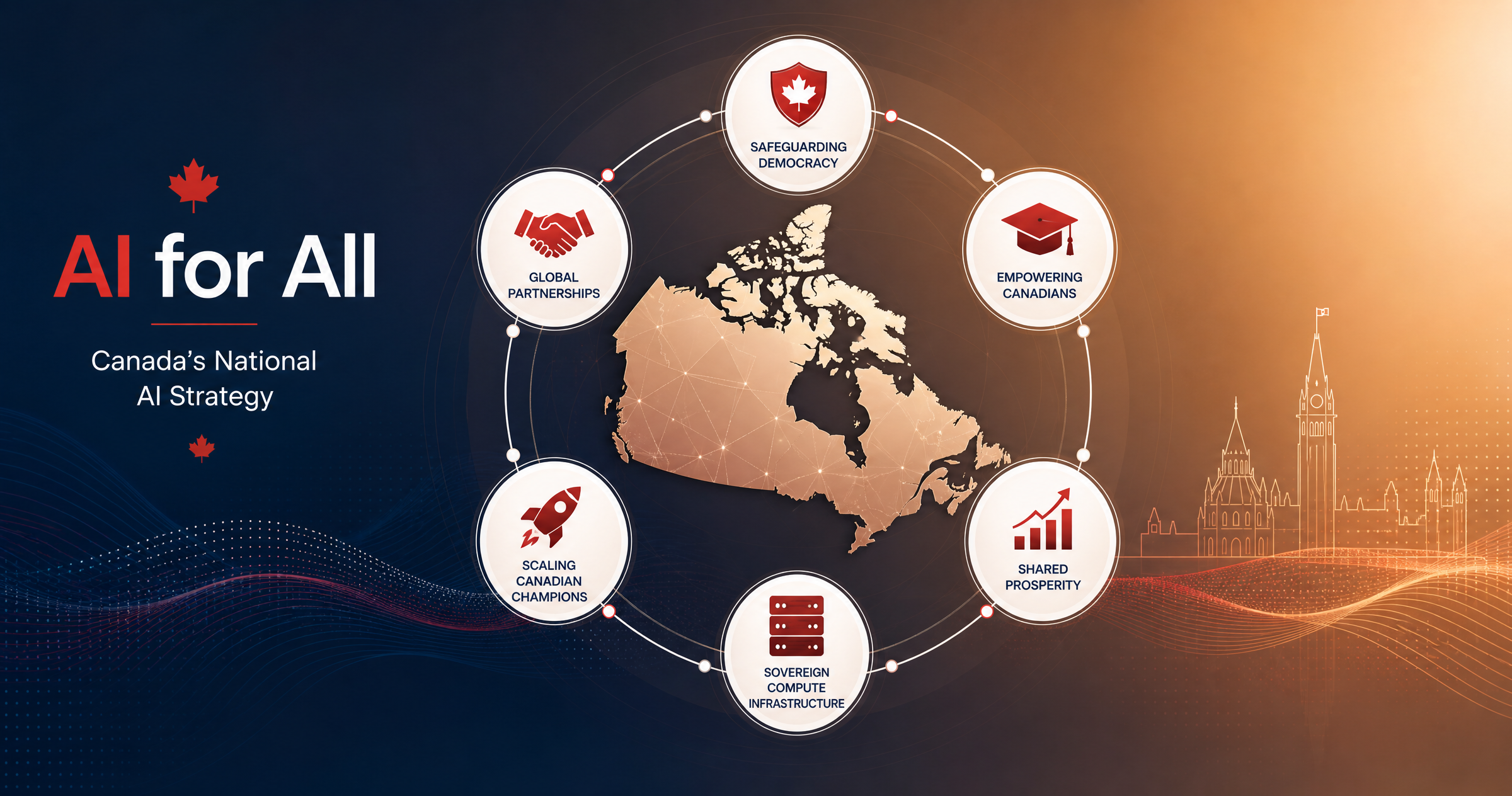
On June 4, 2026, the Government of Canada released “AI for All” — its long-awaited National Artificial Intelligence Strategy. And it’s a big deal.
The strategy is sweeping: six pillars, billions in new commitments, and a clear governing philosophy. Trust enables adoption. Adoption drives prosperity. Sovereignty safeguards both.
It arrives at a moment when AI policy is rapidly crystallizing around the world — the EU AI Act is in force, the US is scrambling for federal framework, the UK is hosting its second AI Safety Summit — and Canada is putting a stake in the ground. Not with a narrow safety bill or a research grant renewal, but with a whole-of-economy industrial strategy.

Here’s what’s in it, what it means, and why it matters.
The Big Numbers
Let’s start with the headline targets, because they tell you everything about the ambition level:
| Metric | Today | Target |
|---|---|---|
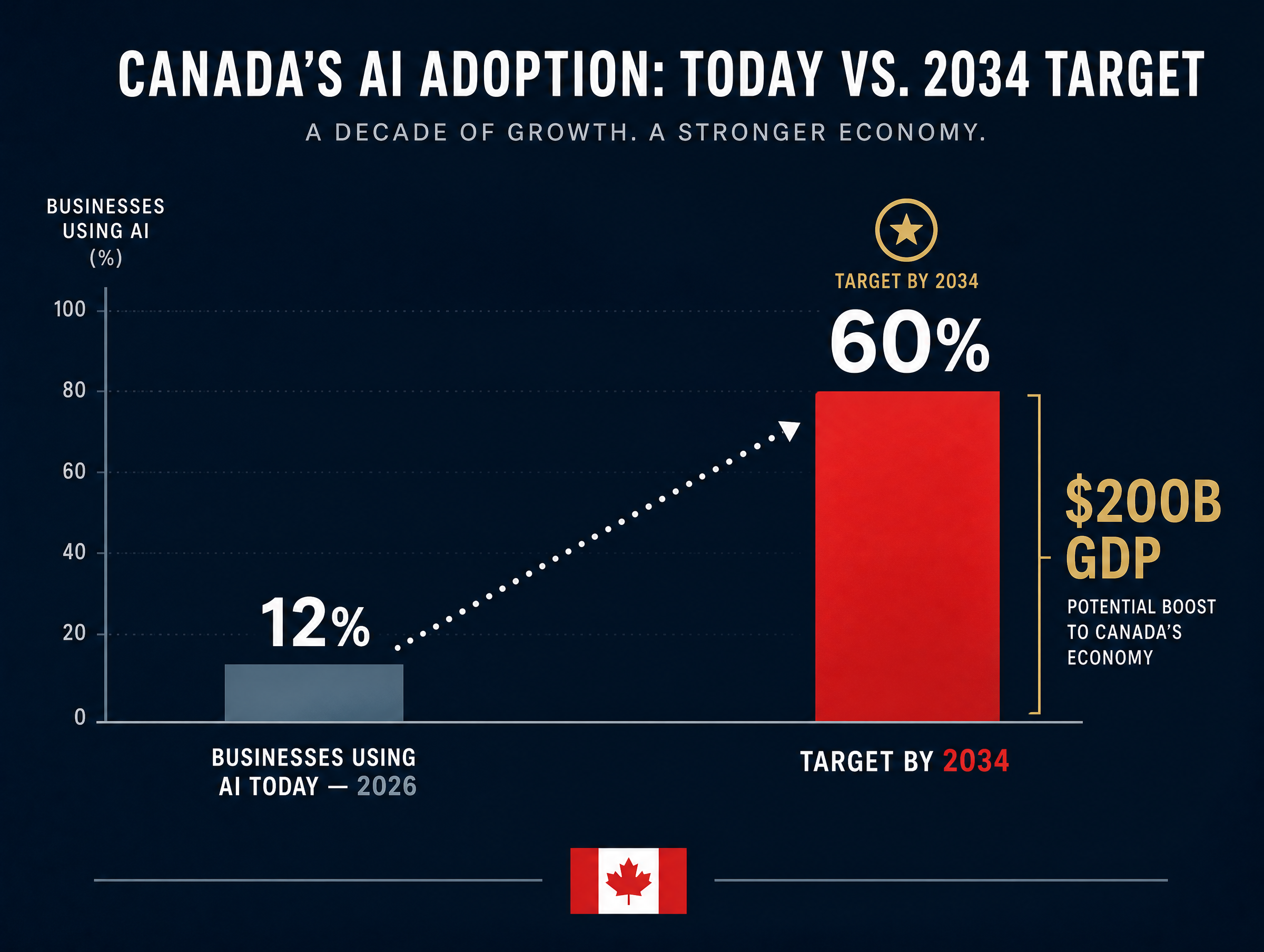
| Business AI adoption | 12% | 60% by 2034 |
| GDP impact from AI-driven productivity | — | ~$200B (3% increase) |
| New AI-related jobs | — | 250,000+ by 2031 |
| Youth work placements | — | 90,000 by 2031 |
| AI literacy: post-secondary students | — | 1M students reached |
| Sovereign compute | Nascent | World-leading supercomputer by 2031 |
| National AI Institutes Chairs | 130 | Nearly 200 |
These aren’t filler targets. A 5x increase in business adoption over a decade, combined with a ~$200B GDP uplift, is a structural economic ambition on par with building the Trans-Canada Highway or the national healthcare system.
The Six Pillars
The strategy is organized around six pillars, grouped into three values: Trust, Opportunity, and Sovereignty.
🔒 Pillar 1: Protecting Canadians and Safeguarding Democracy
Thesis: Canadians won’t adopt what they don’t trust.
This is the most urgent pillar. The strategy explicitly calls out deepfakes, AI-generated disinformation, algorithmic bias, and the weaponization of synthetic media against women and children. The government’s response is multi-layered:
- New consumer privacy legislation enshrining a fundamental right to privacy, with specific protections for children’s data and bans on surveillance pricing
- Online safety laws targeting AI-enabled harms — deepfakes as sexual violence, chatbot safety, and accountability for platforms
- $50M for the Canadian AI Safety Institute (CAISI) — expanded capabilities to track emerging risks, conduct transparent model evaluations, and advance technical safety research
- Canada Trusted AI Certification program — a voluntary but standards-backed seal so businesses and consumers can identify trustworthy AI products
- AI watermarking and transparency requirements so Canadians know when they’re interacting with AI
- Electoral integrity protections against AI-enabled misinformation and foreign interference
- Renewal of the Standards Council of Canada’s AI program to shape global AI standards
- Privacy Act review for the government’s own use of personal information
The AIDA (Artificial Intelligence and Data Act) framework remains the backbone, but Pillar 1 expands well beyond it into privacy, elections, cybersecurity, and consumer protection.
Key insight: Canada is threading a difficult needle here — strong protections without the prescriptive vertical regulation of the EU AI Act. It’s a horizontal, risk-based approach that aims to be rigorous but innovation-permissive. The Trusted AI Certification program is clever: it lets market forces (and procurement requirements) drive safety rather than top-down bans.
📚 Pillar 2: Empowering Canadians
Thesis: Benefits flow through people who understand AI and can use it, not from the technology itself.
This is where the “For All” in AI for All gets real. The strategy identifies three dimensions of empowerment — literacy, opportunity, and participation — and backs them with concrete programs:
- National AI Literacy Initiative — free, accessible entry-level AI training for every Canadian, delivered through schools, public libraries, community organizations, and online platforms
- 1M post-secondary students reached with AI literacy content
- 3,000+ K-12 teachers trained with AI learning kits, reaching an estimated 60,000+ students (leveraging Amii’s existing teacher training programs)
- Trusted AI agents for all post-secondary students — the government will ensure students have access to capable, personal AI tools
- $30M for CanCode — digital skills training for K-12, with emphasis on underrepresented groups
- Job Bank modernization ($50M over 5 years via Budget 2025) — AI-powered job matching that aligns people with opportunities
- 90,000 AI-related job and work placement opportunities by 2031 — 45,000 through Student Work Placement Program and Canada Summer Jobs, 35,000 through Skills for Success, 10,000 through Mitacs ADOPT and AI+X
- Pro-worker industrial AI — the strategy explicitly commits to designing AI that augments workers rather than displaces them, citing OECD data that 80% of surveyed workers said AI improved their performance
- $50M Creative Technology Program — support for Canadian creators using AI on their own terms
- Indigenous-led AI initiatives — supporting language preservation, land management tools, and cultural heritage systems, building on programs like the Indigenous Languages Technology Program at NRC and First Languages AI Reality at Mila
- French language protections — AI systems deployed within government must perform equally well in both official languages
Key insight: The literacy gap is Canada’s binding constraint. Per the strategy, Canada ranks 44th of 47 countries on AI training and literacy, and 42nd of 47 on trust in AI systems. Only 24% of Canadians report any AI training. The SME adoption gap is even starker: ~8% of Canadian SMEs have adopted AI, versus 29-42% in Nordic countries. The strategy correctly identifies that you can’t solve the adoption problem without first solving the literacy problem — and that starts in classrooms and community centres, not boardrooms.
💼 Pillar 3: Powering Shared Prosperity
Thesis: Adoption across the real economy — SMEs, public services, and national missions — is how AI creates broad-based prosperity.
This is the adoption engine of the strategy. The key insight: 78% of non-adopting firms report they don’t see how AI benefits their goods or services. That’s not resistance — it’s a translation problem. Canadian businesses need practical, sector-specific applications with proven value.
The response includes:
- AI Missions Program — targeted, high-impact national projects solving real problems, starting with $200M for health outcomes. The mission model rallies researchers, industry, governments, and communities around concrete challenges — turning Canada’s hardest problems into the engine of its AI adoption.
- SME adoption support — practical pathways from experimentation to integration, recognizing that SMEs (99% of Canadian businesses, employing 14.3M workers) are the critical mass
- Government as anchor adopter — the federal government will lead by example, creating demand for trusted Canadian AI solutions through procurement
- AI-powered government services — transforming public service delivery for better, faster citizen outcomes
- Target: 60% business adoption by 2034 — moving from 12% today to a majority-adopted economy
Key insight: Targeting 60% business adoption by 2034 is the most audacious number in the strategy. It’s roughly 5x the current rate. But it’s not arbitrary — it’s anchored on the reality that Nordic countries are already at 29-42% with less deliberate policy. The question is whether Canada can close the execution gap between ambition and delivery. The Missions Program approach (modelled partly on DARPA-style challenge problems) is a smart structural choice — specific, measurable, and inherently cross-sectoral.
🏗️ Pillar 4: Building the Canadian Sovereign AI Foundation

Thesis: Canada cannot be a full participant in the AI era without sovereign control over the stack — compute, data, talent, and energy.
This is the most capital-intensive pillar, and it reflects a strategic read of the geopolitical landscape. The strategy identifies Canada’s vulnerabilities clearly: sovereign compute is nascent, chip fabrication is foreign, data is siloed, and the path from research to commercialization is too thin.
Key commitments:
- World-leading sovereign supercomputer by 2031 — exact specifications TBD, but the ambition is clear: a nationally-governed compute asset that rivals the best in the world
- $700M expanded Compute Access Fund — affordable sovereign compute for Canadian SMEs so they can train and deploy models on Canadian infrastructure rather than sending dollars and data offshore
- $200M Health Sector Data Space (with CIHI) — linking secure, standardized clinical datasets to accelerate research, clinical trials, and AI-driven diagnostics
- $100M to expand VITAL in five additional provinces — the pan-Canadian health data platform that connects hospital data for AI-driven discovery
- Canada CIFAR AI Chairs expansion — from 130 to nearly 200 world-class researchers anchored at Canada’s three National AI Institutes (Mila, Amii, Vector)
- Expanded Global Talent Stream — accelerated immigration pathways for highly-skilled AI workers, with permanent residency alignment to retain them
- Energy infrastructure — the strategy explicitly links AI compute to the National Electricity Strategy, recognizing Canada will need to double electricity infrastructure by 2050. Canada’s clean, renewable-heavy grid and northern climate are structural advantages for cost-effective, sustainable data centre buildout.
Key insight: Pillar 4 pulls Canada squarely into the sovereign compute race — a domain currently dominated by the US, China, and a handful of European countries building their own national AI infrastructure. The $700M Compute Access Fund is well-directed (SMEs are the biggest adoption bottleneck), but the real story is the supercomputer commitment and the broader recognition that data is a strategic national asset that must be responsibly mobilized, not left siloed. The Health Sector Data Space is a particularly smart opening move: Canada’s universal healthcare system generates clinical data at a scale few countries can match, and responsibly unlocking it for AI-driven research could be a globally competitive advantage.
🚀 Pillar 5: Scaling Canadian Champions
Thesis: Canada builds world-class AI companies, but too many scale under other flags. We need to change the conditions that push them elsewhere.
The strategy is blunt about the problem: nearly 70% of Canadian-led AI startups end up headquartered outside the country. The capital, customers, and talent ecosystem that should exist in Canada is too often captured by Silicon Valley.
Key commitments:
- $500M Canadian Tech Growth Fund — flexible growth capital for Canada’s most promising AI companies, with the ability for the federal government to take equity stakes. This is designed to close the scale-up capital gap that forces Canadian firms to relocate.
- Sovereign Wealth Fund leverage — the recently announced Canadian Sovereign Wealth Fund will co-invest alongside the Tech Growth Fund in emerging national champions
- Reinvestment mechanisms — By Budget 2026, Finance Canada will explore mechanisms encouraging Canadians to reinvest gains from successful tech companies into new Canadian AI startups (modelled on France’s Tibi programme and similar initiatives)
- $1.75B in Budget 2025 VC commitments — leveraging existing federal venture capital investments to address access-to-capital gaps
- $130M for commercialization programs at National AI Institutes — including Founders-in-Residence programs to cultivate a new generation of AI entrepreneurs
- Government as strategic anchor customer — leveraging the Buy Canadian policy to provide domestic scale-ups with revenue and validation for global export
- Foundation model anchoring — the strategy explicitly treats Canada’s frontier model capabilities (Cohere) and safety-by-design research (LawZero/Mila) as strategic assets to be nurtured and scaled from Canadian soil
- SME sovereign compute via $700M Compute Access Fund — ensuring Canadian startups can build products on Canadian infrastructure
Key insight: The $500M Tech Growth Fund with equity-taking authority is a significant policy shift for Canada. It moves the government from grant-funder to active investor and stakeholder in domestic tech champions — similar to what France’s Bpifrance, Singapore’s Temasek, and Japan’s JIC have been doing. The equity stake mechanism means the government can both catalyze growth and capture upside that traditionally flows to foreign acquirers. Structurally, this is the most important capital-markets innovation in the strategy.
The explicit commitment to anchor Cohere and support LawZero is also notable — Canada has one frontier model company and one of the world’s leading AI safety nonprofits, and the strategy recognizes these as irreplaceable strategic assets.
🌐 Pillar 6: Building Trusted Partnerships and Global Alliances
Thesis: Canada cannot go it alone. A coalition of like-minded democracies can offer a credible alternative to closed, monopolized AI ecosystems.
This pillar reflects the geopolitical reality that AI is increasingly being shaped by a small number of dominant actors in the US and China. Canada’s response is to build alliances:
- Sovereign Technology Alliance — launched with Germany in February 2026, this initiative will deepen collaboration on common AI models, shared digital infrastructure, joint research, and aligned safety standards. Plans to expand to additional trusted partners.
- 11 of 20 recent economic/defence partnerships explicitly advance AI cooperation — spanning four continents, covering AI safety standards, sovereign infrastructure, industrial deployment, and B2B matchmaking
- Europe partnerships — Germany (anchor partner via STA), UK (AI safety, standards, defence AI), France (AI governance under G7 presidency), EU (Strategic Partnership of the Future), Finland, Norway
- Indo-Pacific partnerships — Canada-Australia-India trilateral technology partnership (AI, quantum, trade missions), Japan (semiconductors, robotics, industrial AI)
- Middle East partnerships — UAE (sovereign wealth investment in Canadian AI infrastructure), Qatar (AI and emerging technologies), Saudi Arabia (Joint Economic Commission)
- Open-source AI leadership — Canada will lead a global multi-stakeholder effort to invest in and sustain open-source AI development in the public interest, and will support responsible adoption of open-source AI by Canadian researchers, SMEs, and nonprofit organizations
- ALL IN conference — Canada’s largest AI event, with 6,500 participants from 2,500 companies across 40+ countries in 2025
Key insight: The Sovereign Technology Alliance with Germany is the most significant new multilateral AI vehicle to emerge from this strategy. It creates a framework for middle-power democracies to pool resources and build shared infrastructure — an explicit alternative to both US hyperscaler dominance and Chinese state-controlled AI. The open-source AI commitment is strategically smart: it positions Canada to shape the global open-source ecosystem in ways that benefit democratic values and marketplace competition. And the breadth of partnerships (11 AI-specific agreements in one year, covering every major region) shows real diplomatic execution.
Priority Sectors
The strategy identifies five priority sectors where Canada’s scientific, economic, and industrial strengths converge:
- Health and Life Sciences — world-class research + universal healthcare data + fast-growing life sciences sector. The Health Data Space and VITAL expansion are the flagship programs here.
- Energy and Natural Resources — AI for grid optimization, critical mineral supply chains, and clean energy transition. Canada has among the world’s cleanest electricity grids and globally significant critical mineral reserves.
- Transportation — intelligent logistics, autonomous systems, predictive infrastructure. The second-largest country on earth with a trade-dependent economy needs AI-powered movement of goods and people.
- Agriculture — AI-powered precision farming for increased yields, reduced environmental impact, and strengthened global food security. Canada is already among the world’s top agricultural exporters.
- Manufacturing and Robotics — industrial AI and robotics for advanced manufacturing and defence production, responding to persistent labour shortages and reshoring pressures. Dual-use applications with defence implications are explicitly called out.
The Adoption Gap: A Reality Check
The strategy is unusually candid about where Canada stands. Key diagnostic data points:
| Metric | Canada | Leader/Peer |
|---|---|---|
| Business AI adoption | 12% | Nordic: 29-42% |
| SME AI adoption | ~8% | Germany: 26%, France: 18% |
| Individual AI diffusion | 37% (15th globally) | UAE, Singapore, Norway ahead |
| AI training/literacy rank | 44th of 47 | — |
| Trust in AI systems rank | 42nd of 47 | — |
| Canadians with any AI training | 24% | — |
| Canadians who see AI as good vs. harmful | 34% good, 36% harmful | Evenly split |
| Canadians who see AI as existential threat | ~50% | — |
These numbers are sobering for a country that bills itself as an AI pioneer. The strategy’s honesty about them is a strength — you can’t fix what you won’t measure.
What’s Getting Funded
Here’s a consolidated view of the major financial commitments:
| Initiative | Investment |
|---|---|
| Canadian AI Safety Institute (CAISI) expansion | $50M |
| Compute Access Fund expansion (sovereign SME compute) | $700M |
| Canadian Tech Growth Fund (equity + growth capital) | $500M |
| Health Sector Data Space (with CIHI) | $100M |
| VITAL expansion (5 provinces) | $100M |
| National AI Institutes commercialization programs | $130M |
| Budget 2025 VC commitments leveraged | $1.75B |
| CanCode digital/AI skills (K-12) | $30M |
| Creative Technology Program | $50M |
| AI Missions Program — health pilot | $200M |
| Job Bank modernization (Budget 2025) | $50M over 5 years |
| Budget 2025 talent attraction strategy (broader) | $1.7B |
| Budget 2025 IP programs (Elevate IP + IP Assist) | $159M |
These numbers sit alongside significant uncosted commitments: the sovereign supercomputer, the National AI Literacy Initiative, trusted AI agents for post-secondary students, expanded CIFAR AI Chairs, and the Sovereign Technology Alliance expansion.
Reactions
The strategy landed to a predictably mixed reception:
Prime Minister Mark Carney framed it as a choice between inclusive and exclusive AI futures: “The question isn’t whether AI will transform our lives. It will. The question is, will it improve the lives of all Canadians or benefit only a few?”
Conservative deputy leader Melissa Lantsman was sharply critical: “Today’s announcement was a lot of fanfare, short on details and a lot of hollow words from a podium. I think Canadians were expecting real answers on safety, on security, on privacy and on the future of AI in this country.”
Alberta NDP MP Heather McPherson focused on worker representation: “When we look at an AI strategy, we need to make sure that workers are put front and centre. It’s another reason why we need to ensure that strong unions are representing workers in this country.”
OpenAI VP of Global Policy Ann O’Leary welcomed the strategy: “We welcome the leadership of Prime Minister Carney, Minister Solomon and the Government of Canada. We are proud to be a partner to Canada’s AI ecosystem and are committed to helping ensure AI is useful and worthy of people’s trust.”
The political split is predictable: the government selling vision, the opposition demanding specifics, labour seeking worker protections, and big tech offering partnership. The real test will be in implementation.
Analysis: What This Strategy Gets Right
Having read the full document, here’s my take on where it’s strong:
1. The thesis is coherent. Trust ➝ Adoption ➝ Prosperity is a logical chain that connects every pillar. The strategy doesn’t feel like a laundry list of programs — it has a genuine architecture.
2. The candour on Canada’s weaknesses is refreshing. Ranking 44th out of 47 on AI literacy is not the kind of number a government normally leads with, but owning it is the first step to fixing it.
3. The compute strategy is strategically sound. The combination of sovereign supercomputer + SME compute access fund + data centre buildout enabled by cheap clean energy + northern climate is a genuinely differentiated value proposition. Canada can’t outspend the US on GPUs, but it can offer a better total package for compute-intensive AI work.
4. The SME focus is correct. 99% of businesses and 14.3M workers. The 12% → 60% adoption target lives or dies on SME adoption. The Missions Program and sector-specific deployment playbooks are the right tools.
5. The healthcare data play is world-class. Canada’s universal healthcare system generates clinical data at a scale and completeness that most countries cannot match. The Health Data Space and VITAL expansion could be a genuinely world-leading AI-for-health platform.
6. The alliance strategy creates optionality. The Sovereign Technology Alliance, the 11 AI-specific international partnerships, and the open-source AI commitment give Canada multiple channels to build sovereign capability without going it alone.
What Deserves Scrutiny
1. Is $500M enough for the Tech Growth Fund? France’s Tibi programme is €6B. The US CHIPS Act is $52B. Canada’s ambition to create national champions with $500M in flexible capital is credibly starter-level, but it’s not a game-changer on its own.
2. The supercomputer timeline to 2031 is too slow. Five years from now in AI is multiple generations. A world-leading supercomputer in 2031 may be merely adequate by then. The strategy should have a nearer-term compute milestone.
3. The literacy-to-adoption pipeline is ambitious but unproven. Training 1M students and 3,000 teachers is a solid start, but moving Canada from 24% AI-trained to a majority-AI-literate population in under a decade requires execution at a scale the government hasn’t demonstrated.
4. No explicit compute governance or procurement model. The supercomputer commitment is big, but there’s no detail on how it will be governed, who gets access on what terms, or how it will interoperate with the SME compute access fund. The devil is in those details.
5. The energy constraint is real. Canada will need to double electricity infrastructure by 2050. Current buildout timelines for new generation, transmission, and data centre permitting are measured in years. The strategy acknowledges the constraint but doesn’t offer a fast-track solution.
6. Equity stakes in tech companies are a new policy tool for Canada. The $500M Tech Growth Fund’s ability to take equity positions is a meaningful departure from historical Canadian innovation policy. It has the potential to capture upside that currently flows offshore, but it also introduces political risk, governance complexity, and the question of whether the government can effectively pick winners.
Bottom Line
Canada’s AI for All strategy is serious. It’s not a research grant renewal dressed up as a strategy — it’s an industrial policy anchored in a clear diagnosis of Canada’s strengths (research, talent, energy, institutions, international trust) and weaknesses (adoption, literacy, compute sovereignty, scale-up capital).
The execution challenge is enormous. Canada’s track record of implementing ambitious national strategies is mixed at best. The difference this time is that global competition in AI will not wait for domestic political cycles — the US, EU, China, and a growing cohort of middle-power competitors (UAE, Singapore, Japan, India) are all moving fast.
But Canada has structural advantages most countries would envy: a clean energy grid, a northern climate, world-leading AI research anchored by three Nobel/Turing laureates, a universal healthcare system with data assets no private company can match, and a growing network of international partnerships. The strategy identifies those advantages and builds around them.
Whether Canada executes is now the question. But for the first time, it has a coherent national answer to what it wants to be in the AI era.
Sources: Government of Canada — Canada’s National AI Strategy: AI for All, released June 4, 2026. Reaction quotes from The Canadian Press. Supplementary reporting from iPolitics, BetaKit, Global News, and the Toronto Star.
Further Reading
- 🔗 Full strategy document (PDF) — Government of Canada
- 🔗 Artificial Intelligence and Data Act (AIDA) companion document
- 🔗 Pan-Canadian Artificial Intelligence Strategy overview
- 🔗 Canada’s AI ecosystem
- 🔗 Statistics Canada — AI adoption and technology measurement
- 🔗 Canadian AI Safety Institute
- 🔗 ALL IN Conference — Canada’s largest AI event
- 🔗 Cohere — Canadian frontier model company
- 🔗 Mila — Quebec AI Institute
- 🔗 Amii — Alberta Machine Intelligence Institute
- 🔗 Vector Institute for AI
- 🔗 Blog: Canada’s sovereign compute race — byMAR.CO (more coming soon)